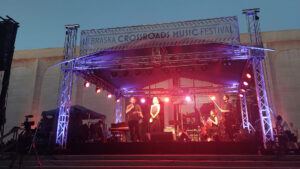
The Back Story
Almost three decades ago, in 1998, Nebraska created something genuinely unique: the Nebraska Cultural Endowment — the first and only public-private cultural trust in the United States designed to support both arts and humanities through a state matching mechanism.
If you’ve never heard about it, I wouldn’t be surprised. It doesn’t advertise itself loudly, and it was never meant to. But the idea behind it is, in many ways, quietly brilliant.
Here’s how it works in human terms. When private individuals, families, and foundations donate to the Endowment, the State of Nebraska matches those gifts. The combined funds are not spent all at once. They are invested as a permanent endowment, and the earnings are used to support arts, music, history, literature, education, and civic programming across the state. This structure was designed to do something very specific: protect cultural and educational work from the volatility of annual budgets and political cycles.
As of 2026, the Endowment totaled roughly $35 million and generated over $1 million annually for programs reaching communities throughout Nebraska — including places that do not have large donor bases or easy access to philanthropic capital. It took decades to build this system. It exists because Nebraska once chose to think long-term.
And that is why what is happening now matters.
In January 2026, the Governor’s mid-biennium budget proposal included a recommendation to remove $15 million from Nebraska’s Cultural Preservation Endowment Fund and transfer it into the state’s General Fund. On paper, this looks like a small technical adjustment. But it isn’t.
That $15 million is not a one-time program allocation. It is principal — money designed to remain invested and generate ongoing support for arts and humanities across the state, year after year, generation after generation. To understand the scale of this decision, the numbers help. Nebraska’s General Fund appropriations for FY 2026–27 are approximately $5.64 billion. Against that backdrop, $15 million represents about 0.27% of one year’s General Fund budget — less than one-third of one percent.
This is not a structural fix for the state budget, and it is not a transformative infusion of resources. But for Nebraska’s cultural infrastructure, it is enormous.
The proposal suggests replacing this long-term mechanism with a direct General Fund appropriation of approximately $600,000 per year, framed as a more “stable” alternative to fluctuating investment earnings. I understand the instinct behind that argument. Stability matters. Anyone who works in the arts understands instability intimately.
Real Cultural Stability
I’m not a policymaker. But if the goal is truly “stability,” wouldn’t the most responsible path be to keep the $15 million principal intact and build stability around it—rather than dismantle it? Keep the endowment working in strong years, and in weaker years authorize a temporary General Fund backstop so distributions don’t drop below a reasonable floor. That would protect programs from volatility without permanently eliminating the very mechanism Nebraska created to think long-term.
There is a fundamental misunderstanding embedded in the idea that annual appropriations are inherently more stable. Annual appropriations are never guaranteed. They are renegotiated every budget cycle. They are vulnerable to political pressure. They can shrink or disappear quietly when priorities shift. Endowments exist precisely because some public goods need protection from short-term thinking — and they are meant to outlast individual administrations and temporary fiscal stress. Once the principal is removed, that protection is gone.
I’m writing this as someone who has watched music, arts, and the humanities change real people up close. I’ve seen students find a voice they didn’t know they had, communities move from being strangers to being connected, and people gain language for grief, joy, and belonging — things they had felt but never been able to name.
Human Infrastructure
There is one issue with this kind of impact: it is almost invisible while it’s happening. It doesn’t come with instant metrics or flashy headlines, and it rarely shows up on a balance sheet. It works quietly, over time. It shows up in deeper thinking, stronger empathy, and a shared sense of meaning. This is human infrastructure, and like all infrastructure, you don’t notice it until it starts to disappear.
A market economy is very good at producing entertainment and distraction, but it is not designed to protect depth, reflection, or shared memory. That is why every healthy society — historically and today — has made deliberate choices to support arts and humanities beyond what the market alone can sustain. The real question is not whether culture can “pay for itself” like a product. It can’t, because it isn’t one.
The real question is whether we want a Nebraska where arts and humanities slowly become the privilege of those who can afford them, like in older centuries when culture belonged to courts and elites — or a Nebraska where every child, every town, and every community has access to meaning, beauty, memory, language, and imagination: the deeper human things that make a society worth living in — and that Nebraska is now being asked to trade away for less than one-third of one percent of one year’s General Fund budget.
There is still time to influence the outcome — but only if people who care speak up in a way lawmakers can actually count.
For additional reporting and context on the proposal, you may find this local coverage helpful:
https://www.3newsnow.com/central-omaha/nebraska-arts-programs-face-cuts-as-governor-proposes-budget-changes
How to Submit a Public Comment Opposing LB 1072 (Before 8:00am, Feb 11)
Submitting a comment is simple, but the form is not intuitive, so please follow the steps below carefully.
Deadline
Before 8:00 a.m. on Wednesday, February 11, 2026
This comment must be submitted specifically for the Arts Agency (Agency 69).
Important:
Even if you already submitted a comment opposing LB 1072 earlier, you need to submit it again for Agency 69 so it is officially on record for the Arts Agency hearing.
1) Step-by-Step Instructions
- Go to the public comment page:
https://t.ly/NXf0i - Scroll down the page
Do not stop at the top — the comment sections are listed by agency, not by bill. - Find “Arts Agency (Agency 69)”
You may need to scroll quite a bit. Look specifically for:Arts Agency (Agency 69)
- Click the option to submit a written comment
Make sure you are submitting your comment under Agency 69, not another agency. - Paste or write your comment
You can use the sample text below and personalize it if you wish. - Submit before 8:00 a.m., Feb 11
That’s it — your comment will be officially recorded for the Arts Agency hearing.
Sample Comment (Copy & Paste)
You can copy this text and adjust it if you like:
“I am a Nebraska resident and I oppose LB 1072. The Cultural Preservation Endowment Fund is a long-term investment created in 1998 to support arts and humanities statewide through a public-private match. Removing the $15 million principal and replacing it with an uncertain annual appropriation weakens the stability this endowment was designed to provide. Please protect this unique long-term public resource.”
or even shorter:
“I oppose LB 1072 and urge you to keep the Cultural Preservation Endowment Fund intact. Nebraska’s public-private cultural match is a long-term investment that cannot be replaced by an uncertain annual appropriation.”
2) You also could CONTACT A MEMBER OF THE APPROPRIATIONS COMMITTEE
Email or send a letter to a member of the Appropriations Committee.
Members of the Appropriations Committee:
Sen. Robert Clements, Chairperson
3) Share this with others.
If you care about education, community life, and Nebraska’s long-term future, please share this article and encourage others to comment too. Quiet decisions shape the future just as much as loud ones — and this is one of those moments.